
Vietnam’s Carbon Market Takes Shape: From Pilot’s Allowances to Corporate Readiness
Updated: Aug 31
Vietnam has taken an important step in its low-carbon transition with the official launch of its domestic carbon trading platform on 29 June 2026. Operated through the Hanoi Stock Exchange, the platform marks the country’s shift from regulatory preparation and market simulations toward the practical operation of a domestic carbon market.
Although the market remains in a pilot phase, the launch establishes the infrastructure needed to register, trade and settle greenhouse-gas emission allowances and eligible carbon credits. It also signals that emissions are beginning to move beyond environmental reporting and become a measurable financial and strategic consideration for businesses.
A Market Built on Existing Financial Infrastructure
Rather than creating an entirely separate trading system, Vietnam has integrated carbon trading into its existing securities-market infrastructure. The Hanoi Stock Exchange operates the platform, while supporting institutions manage registration, custody, ownership transfer and settlement.
The market covers two main types of carbon assets. Emission allowances represent the permitted quantity of greenhouse gases allocated to covered facilities, while carbon credits represent verified emission reductions or removals generated by eligible projects or activities.
Companies that emit below their allocated levels may retain or sell surplus allowances. Those exceeding their allocations may need to purchase additional allowances or use eligible carbon credits, subject to compliance rules. This creates an incentive for companies to improve energy efficiency, adopt cleaner technologies and reduce future carbon costs.
The Pilot Market and Its First Price Signal
Vietnam’s pilot emissions trading system initially focuses on three carbon-intensive sectors: thermal power, iron and steel, and cement. These sectors were selected because of their emissions intensity, economic importance and exposure to international carbon-related trade requirements.
For the 2025–2026 period, the government approved a pilot allowance budget of approximately 511 million tonnes of carbon dioxide equivalent. The market recorded its first greenhouse-gas allowance transaction on the opening day at VND 136,000 per tCO₂e, equivalent to approximately USD 5.3.
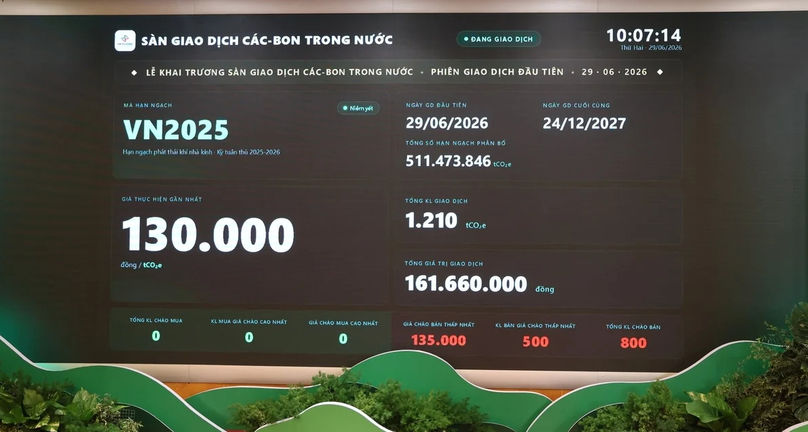
This transaction provides Vietnam with an initial domestic carbon-price signal, but it should not yet be treated as an established market benchmark. Future prices will depend on allowance supply and demand, market participation and liquidity, and the strength of compliance and enforcement.
The pilot will continue through the end of 2028, with trading service fees waived to encourage participation and allow companies to build experience. Full market operation is currently planned from 2029.
Why the Launch Matters for Businesses
For Vietnamese businesses, the exchange changes how greenhouse-gas emissions need to be understood and managed. Emissions are no longer relevant only for sustainability reports or regulatory disclosures; they may increasingly create direct financial consequences.
A company that exceeds its allowance allocation may face the cost of purchasing additional allowances. Conversely, a company that reduces emissions below its allocation may hold a tradable asset with potential market value. Carbon performance can therefore influence operating costs, investment planning and competitiveness.
This shift is particularly relevant for energy-intensive and export-oriented businesses. International buyers are increasingly requesting product carbon-footprint data, supply-chain emissions information and evidence of credible decarbonization efforts. Vietnamese exporters in sectors such as steel and cement also face growing carbon-related requirements in overseas markets.
The immediate question is therefore not whether every company should begin trading, but whether businesses have the data, systems and strategies needed to understand their exposure and respond effectively.
Companies can begin by focusing on four practical areas:
Build a reliable emissions baseline and MRV system
Develop organizational- and facility-level greenhouse-gas inventories, define reporting boundaries and strengthen monitoring and verification.
Assess allowance and carbon-price exposure
Compare current and projected emissions with potential allowance allocations and evaluate the financial impact of different price scenarios.
Develop an emissions-reduction roadmap
Prioritize opportunities such as energy efficiency, renewable-energy procurement, fuel switching, cleaner production and technology upgrades.
Understand carbon-credit eligibility
Monitor which credits, methodologies and project categories may be recognized under Vietnam’s compliance framework.
These steps can help companies integrate carbon considerations into budgeting, capital expenditure, procurement, risk management and long-term business planning.
What Comes Next
Vietnam’s carbon exchange marks the beginning of the country’s carbon-pricing journey rather than the completion of the market. During the pilot period, authorities will need to improve emissions-data quality, clarify allowance allocation and credit eligibility, strengthen oversight and encourage sufficient participation to support credible price discovery.
For businesses, carbon management is increasingly becoming a financial and strategic priority. Companies that build reliable emissions inventories, practical reduction plans and internal carbon-market capabilities now will be better positioned as the system expands.
As Vietnam’s domestic carbon market continues to evolve, the next challenge for businesses will be translating regulatory progress into practical compliance, investment and decarbonization strategies. At Mt. Stonegate, we support organizations in navigating evolving carbon-market requirements and strengthening corporate readiness. Our carbon market and sustainability specialists provide guidance on emissions inventories, allowance exposure, carbon-credit eligibility and broader decarbonization pathways.


Comments