
SRUK Goes Live: A Major Milestone for Indonesia’s Carbon Market
Updated: Aug 31
Indonesia has entered a new phase in the development of its carbon market ecosystem. On 9 July 2026, the Ministry of Environment officially launched the Sistem Registri Unit Karbon (SRUK), a national carbon registry designed to serve as the backbone of carbon market governance under Presidential Regulation (Perpres) No. 110 of 2025 on Carbon Economic Value (NEK) Instruments and National Greenhouse Gas Emission Control.

The Role of SRUK: Project Registration to Retirement
At its core, SRUK functions as Indonesia's national carbon registry and the official record for all carbon units generated, traded, and retired within the country. The platform manages the entire lifecycle of carbon units, beginning with the registration of mitigation activities and project documentation, followed by the issuance of carbon units (SPE-GRK/Non SPE-GRK), ownership transfers, trading activities, and ultimately retirement once the units are used to meet climate commitments.
By centralizing these processes within a single system, SRUK creates a transparent chain of custody for every carbon unit. This traceability is particularly important in preventing “double counting,” where the same emission reduction could otherwise be claimed by multiple parties.
The government has also emphasized that SRUK is designed to support interoperability with international carbon registries, positioning Indonesia to participate more effectively in both domestic and international carbon transactions.
Sectoral Coverage
Under the framework of Perpres No. 110 of 2025, SRUK is designed to integrate six key sectors: forestry, energy, industry (IPPU), agriculture, waste management, and marine and fisheries. While each sector is responsible for establishing its own specific mechanisms and procedures, the forestry sector has emerged as the first to successfully implement these regulations under Permenhut No. 6 of 2026.

This development was preceded by the launch of the Indonesia Forestry Carbon Hub (IFCH) on 6 July 2026, which aims to create a dedicated ecosystem for forestry carbon transactions and project development.
As part of the initial implementation phase, the government approved four pioneering forestry carbon projects consisting of three Persetujuan Berusaha Pemanfaatan Hutan (PBPH) concession holders and one Social Forestry project (Katingan Peatland Restoration and Conservation Project in Central Kalimantan, the Sumatra Merang Peatland Project in South Sumatra, The Mayas Project in West Kalimantan, and the Bujang Raba Social Forestry Project in Jambi). Collectively, these projects represent approximately 31.7 million tonnes of potential emission reductions, with an estimated transaction value of around IDR 5 trillion and projected non-tax state revenue (PNBP) of approximately IDR 500 billion.
The inclusion of a Social Forestry project Is particularly notable, as It signals the government's intention to create a more inclusive carbon market that extends beyond large concession holders and provides opportunities for local communities to participate in carbon finance mechanisms.
Market Integrity: Strengthening Integration With IDX Carbon
Alongside the launch of SRUK, the Ministry of Environment announced plans to integrate the national carbon registry with Indonesia’s carbon exchange, IDX Carbon. During the launch, Friderica Widyasari Dewi, Chair of the OJK Board of Commissioners, emphasized that this integration ensures that the entire process starting from recording to retirement can be traced transparently. This synergy, supported by POJK No. 10 of 2026, is designed to increase market liquidity while protecting investors from risks such as greenwashing and excessive speculation.
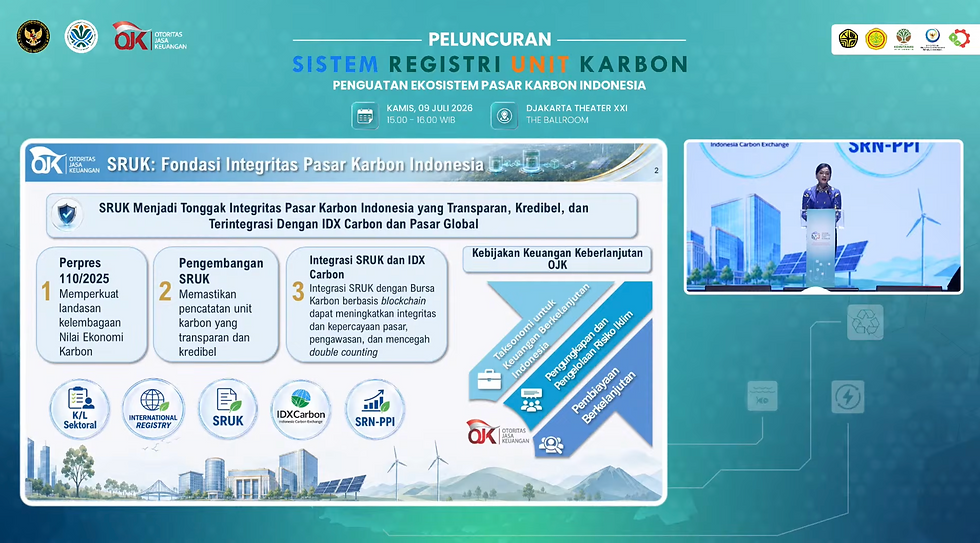
However, operational implementation will continue to depend on sector-specific regulations and procedures. While the forestry sector has already established its framework under Minister of Forestry Regulation No. 6 of 2026, other sectors are still in the process of developing the technical mechanisms and implementation arrangements required to participate in the system.
What This Means for Businesses
The launch of SRUK signals that Indonesia's carbon market is moving from policy development toward implementation. For project developers, the new system provides a clearer pathway for project registration, issuance, and market participation. For investors, it introduces greater transparency and regulatory certainty. For corporate buyers, it creates a more structured mechanism for sourcing and managing carbon units.
More broadly, the development reflects a growing expectation that climate claims must be supported by robust data, transparent methodologies, and independent verification.
Organizations seeking to participate in carbon markets, whether as project developers, investors, or buyers will increasingly need to demonstrate that their emission reductions are measurable, verifiable, and aligned with national requirements. As additional sectors such as energy, waste management, agriculture, and marine resources prepare their implementation frameworks, Indonesia's carbon market is expected to expand significantly in both scale and sophistication.
Looking Ahead
With SRUK now in place, Indonesia's carbon market is entering a new phase of development. As this ecosystem evolves, organizations will need to understand not only where compliance requirements are heading, but also where new opportunities for value creation may emerge.
For organizations navigating this transition, Mt. Stonegate provides market intelligence, carbon market advisory, renewable energy solutions, and sustainability strategy support, helping businesses turn climate ambition into measurable and credible action.
References:
Ministry of Environment of the Republic of Indonesia. Launching Sistem Registri Unit Karbon (SRUK). Available at: Launching Sistem Registry Unit Karbon (SRUK) Recording (accessed 13 July 2026).
Ministry of Environment of the Republic of Indonesia. Sistem Registri Unit Karbon (SRUK). Available at: SRUK Indonesia Portal (accessed 13 July 2026).
Ministry of Forestry of Republic of Indonesia. Peluncuran Sistem Perdagangan Karbon. Available at: Peluncuran Sistem Perdagangan Karbon (accessed 13 July 2026).


Comments