
From Policy to Practice: Key Takeaways from the Carbon 360 Workshop
Updated: Aug 31
Indonesia’s carbon market is entering a critical phase. As government efforts to establish carbon pricing and carbon market mechanisms accelerate and interest from corporates and project developers grows, the market is moving from early development toward greater structure and accountability. While the compliance carbon market remains under development and piloting, the voluntary market is increasingly shaped by global integrity frameworks such as ICVCM, Gold Standard, and Verra, raising expectations for transparency, credibility, and responsible participation. At the same time, corporate climate action in Indonesia is evolving, with companies expected to integrate credible market participation, renewable energy commitments, and ESG considerations into long-term business strategies.

Against this backdrop, Mt. Stonegate’s team conducted “Carbon 360 – Driving Indonesia’s Corporate Climate Action through Carbon Market and ESG Synergy” on 2 December 2025. Supported by E-Square Inc. and the Indonesia Center for Renewable Energy Studies (ICRES), the workshop brought together policymakers, industry leaders, corporate representatives, and sustainability practitioners to examine how regulation, market mechanisms, and corporate strategies must align as Indonesia advances its climate and energy transition agenda.
Aligning Policy, Market Readiness, and Sectoral Pathways
The workshop opened with keynote addresses from senior government representatives, setting the policy and sectoral context for Indonesia’s evolving carbon market. Dr. Wahyu Marjaka, Director of Carbon Economy Value Implementation at the Ministry of Environment, outlined Indonesia’s progress in developing its compliance carbon market framework. He emphasized the need to align policy instruments, governance structures, and market mechanisms to ensure environmental integrity and institutional readiness as carbon pricing moves toward broader implementation.
From the industrial perspective, Fausan Arif Darmadi, Industrial Management Advisor at the Center for Green Industry, Ministry of Industry, highlighted the role of emissions trading in supporting industrial decarbonization. He noted that climate action is increasingly linked to industrial competitiveness and access to sustainable finance, particularly as global markets adopt more stringent carbon-related standards and trade requirements.
The discussion then turned to the forestry sector, where Ilham, S.T., M.T., Director of Forest Utilization Business Development at the Ministry of Forestry, underscored the strategic role of forest-based carbon projects within Indonesia’s carbon market ecosystem. He highlighted the importance of clear regulations, robust safeguards, and long-term governance to ensure forestry initiatives deliver high-integrity credits alongside meaningful social and environmental benefits.
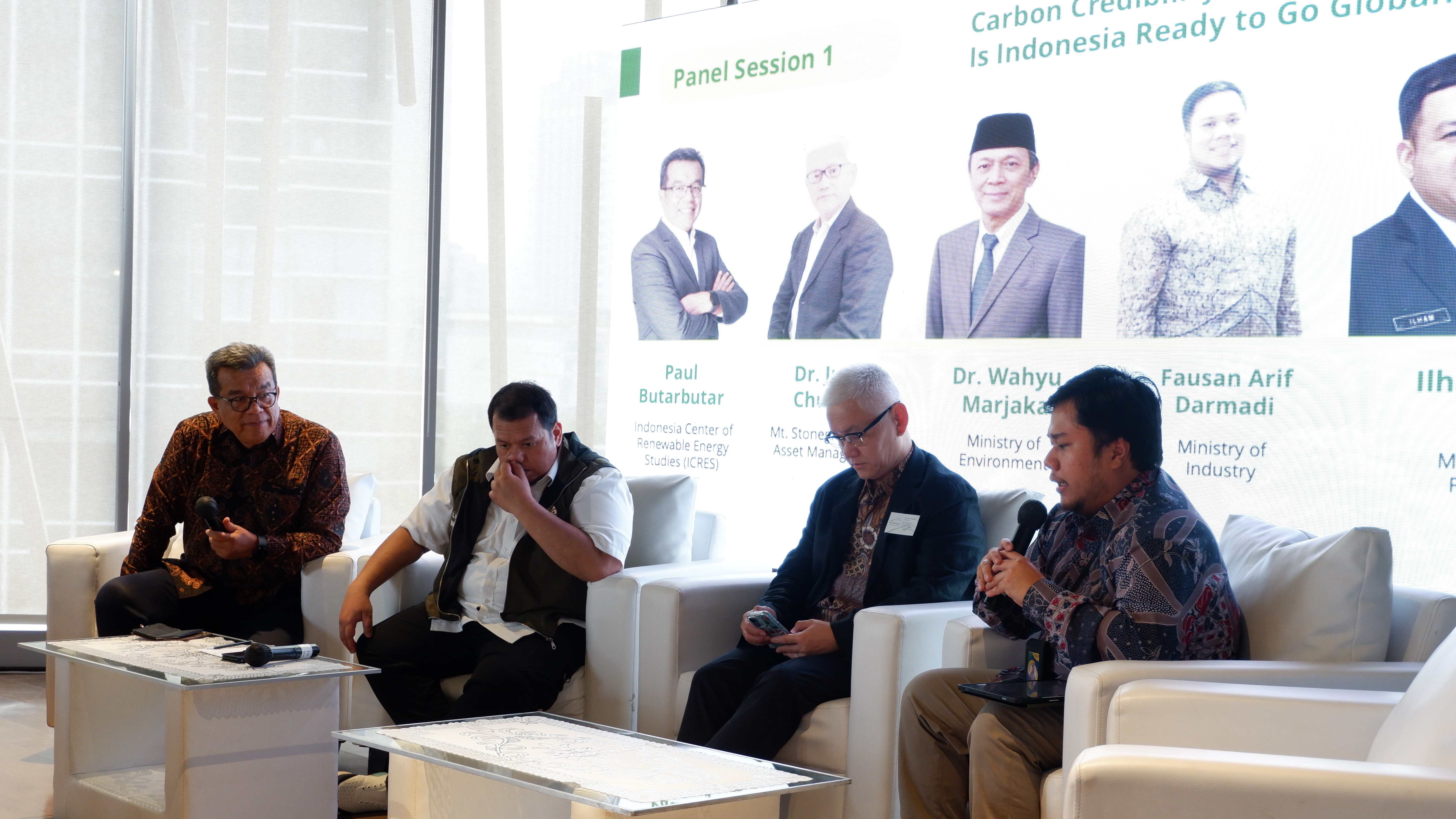
These sectoral perspectives were further examined in a high-level panel discussion moderated by Paul Butarbutar, Co-Founder and Executive Director of ICRES. The panel featured Dr. Jules Chuang, Founder and Managing Director of Mt. Stonegate, alongside representatives from the Ministry of Industry and Ministry of Forestry. The discussion explored Indonesia’s readiness to engage more actively in global carbon markets, emphasizing policy certainty, cross-sector coordination, and collaboration between public and private stakeholders as key foundations for a credible and resilient carbon market.
Inside the Dialogue: ESG and Corporate Decarbonization
Building on the policy discussions, the workshop shifted its focus toward corporate implementation, examining how ESG frameworks and decarbonization strategies are translated into business decisions. Albert Sutanto, Manager of Southeast Asia Market at Mt. Stonegate, highlighted how corporate climate strategies are increasingly shaped by investor expectations, regulatory developments, and market-based instruments. He emphasized that credible decarbonization pathways require a balanced combination of direct emissions reduction, renewable energy procurement, and responsible engagement with carbon markets.
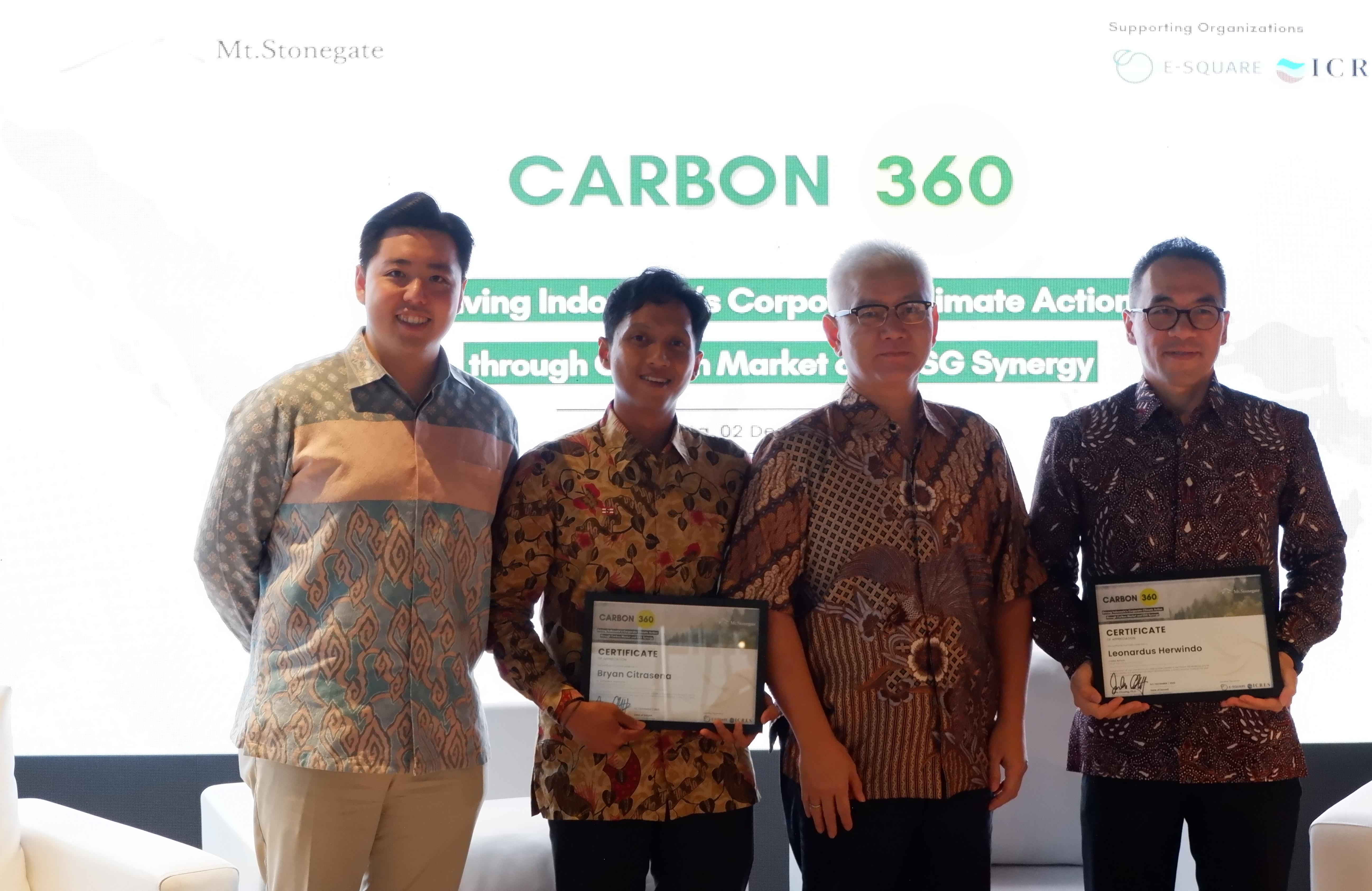
Corporate perspectives were further grounded through insights from Bryan Citrasena, Corporate ESG Specialist at PT Samudera Indonesia, and Leonardus Herwindo, CEO of Indika Nature. Bryan Citrasena highlighted the importance of embedding ESG into core business processes of PT Samudera Indonesia, emphasizing the need for stronger internal coordination between sustainability teams, operational units, and management to translate ESG commitments into measurable action. Meanwhile, Leonardus Herwindo outlined Indika’s strategic transition from a coal-focused business toward a diversified portfolio centered on nature-based solutions and sustainable sectors. He emphasized that the shift reflects a long-term effort to reduce exposure to carbon-intensive assets while unlocking opportunities linked to biodiversity, natural capital, and climate-positive investments, supported by changes in governance, risk management, and capital allocation.
Global Perspectives on Markets, Energy, and Net-Zero Pathways
The workshop concluded with insights from global experts who positioned Indonesia’s carbon and ESG developments within broader international market and policy trends. David Harris, Head of Sustainable Finance Strategic Initiatives & Partnerships at London Stock Exchange Group (LSEG), together with Alexis R. Raccamora, Sustainable Finance & Investment Lead for APAC, discussed how ESG ratings and sustainability disclosures are increasingly shaping capital allocation decisions. They emphasized that consistency, data quality, and transparency are becoming critical for companies seeking access to global capital markets and sustainable finance.
Complementing this perspective, Ken Oikawa, CEO of E-Square Inc., highlighted the importance of market credibility and cross-border alignment as corporates operate across multiple jurisdictions. He noted that harmonizing ESG practices and carbon market participation with international expectations is increasingly essential for companies integrated into regional and global supply chains.
The discussion then turned to the energy transition, with Laura Thomas, Policy Manager at the Climate Group, outlining how corporate renewable electricity procurement—through initiatives such as RE100—is driving companies to move from target-setting toward implementation. Looking ahead, Shailesh Telang, Head of Asia Pacific at EnergyTag, introduced the concept of 24/7 carbon-free energy, highlighting the growing importance of granular energy accounting in enabling deeper, system-level decarbonization.
Conclusion
The Carbon 360 workshop underscored that Indonesia’s climate and energy transition will depend on how effectively carbon markets, ESG frameworks, and corporate strategies evolve together. Across policy discussions, corporate case studies, and global insights, the event highlighted the importance of regulatory clarity, market credibility, and practical implementation in delivering measurable climate outcomes. As Indonesia strengthens its carbon market ecosystem, the workshop reinforced that corporate engagement will be a decisive factor in translating policy ambition into real economy impact.
As this transition unfolds, Mt. Stonegate provides integrated carbon management services to help organizations assess their current position, allocate resources effectively, and design practical, customized decarbonization pathways. We invite companies to connect with us, share their challenges, and explore how uncertainty can be translated into a clear and sustainable roadmap for the future.


Comments